
Olive oil, water and lye. From a remarkably short list of ingredients, people around the Mediterranean have been making soap for centuries.
The process may sound simple, but behind it is a precise chemical reaction called saponification. When oils are combined with a carefully calculated solution of sodium hydroxide and water, they are transformed into soap and naturally occurring glycerin.
This basic chemistry lies behind some of Europe’s best-known soap-making traditions, from Castile soap in Spain to Savon de Marseille in southern France. Making an olive oil soap recipe at home offers a fascinating way to understand how such simple ingredients can become something we use every day.
Different oils create different qualities in a finished soap. Olive oil is naturally rich in oleic acid and is particularly known for producing a mild bar with a fine, creamy lather rather than the large, airy bubbles created by some other soap-making oils.
The appeal of traditional olive oil soap also lies in its simplicity. A basic formula requires very few ingredients and doesn’t need added colourants or synthetic fragrance to create a functional everyday cleanser. For anyone interested in understanding exactly how an everyday product is made, that simplicity is part of what makes olive oil soap so interesting.
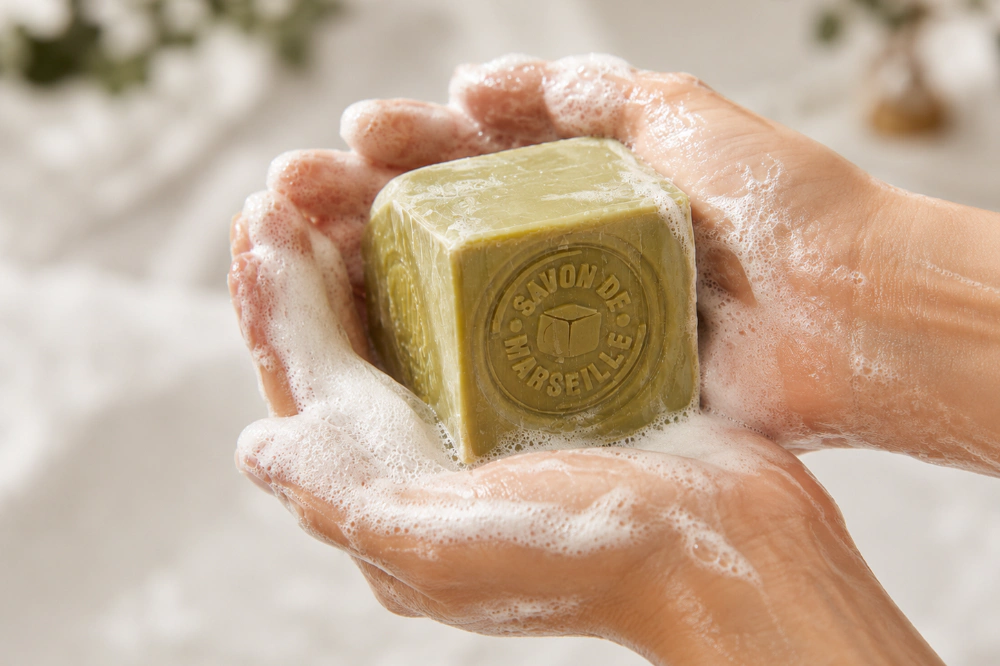
There is a reason olive oil has remained such an important soap-making ingredient for centuries. Naturally rich in oleic acid, it produces a characteristically mild soap with a fine, creamy lather rather than the large, airy bubbles created by some other soap-making oils. Traditional olive oil soap can also be remarkably simple, requiring very few ingredients to create an effective everyday cleanser.
What makes olive oil soap interesting is ultimately quite simple: it combines effective cleansing with a formula and soap-making tradition that have changed remarkably little over centuries.
[Image Idea: An overhead flat lay of the soap-making tools: a digital scale, heat-resistant containers, an immersion blender, protective goggles and a bottle of olive oil arranged on a clean workshop table.]
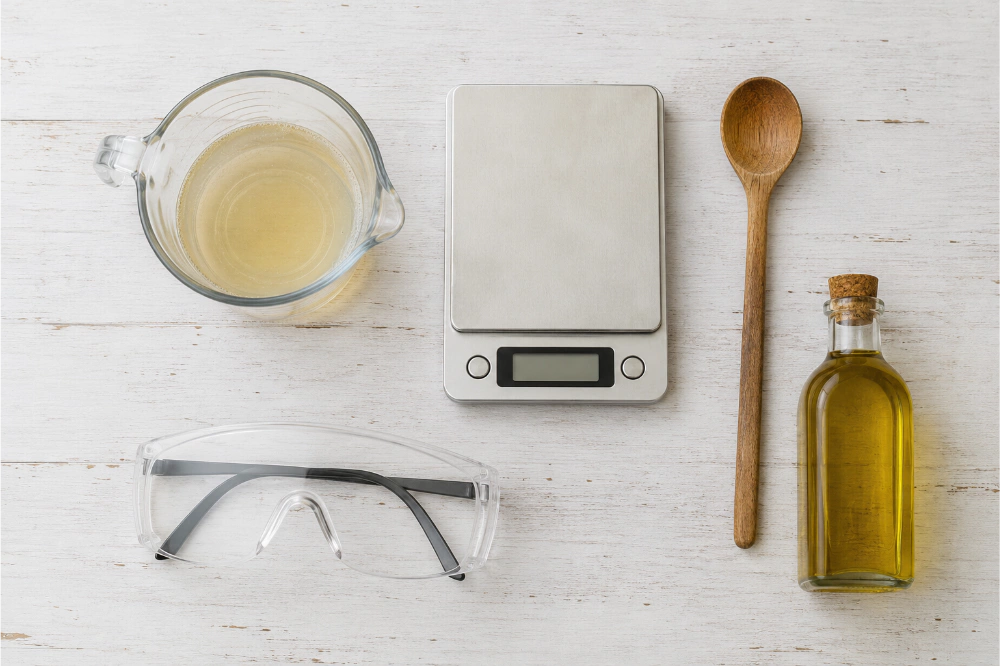
Cold-process soap making requires patience and precision, particularly because sodium hydroxide is highly caustic before saponification takes place.
The quantities of olive oil, sodium hydroxide and water must always be accurately calculated for the specific recipe. Different oils have different saponification values, so lye quantities should never be guessed or changed without recalculating the formula.
Safety & Equipment
Protective goggles and chemical-resistant gloves are essential. Always work in a well-ventilated area, away from children and pets.
You will also need a precise digital scale, thermometer, immersion blender, suitable heat-resistant containers and silicone soap moulds. Keep soap-making equipment separate from utensils used for food.
The Ingredients
Step 1: Preparing the Lye Water
Put on your protective equipment and accurately weigh the distilled water and sodium hydroxide separately.
Slowly add the lye to the water, never water to the lye, stirring carefully until dissolved. The solution will heat rapidly. Avoid leaning over the container or breathing the vapour produced immediately after mixing, then leave the solution in a secure, well-ventilated place to cool to the temperature required by your recipe.
Step 2: Preparing the Olive Oil
Accurately weigh the olive oil and pour it into your mixing container. Since olive oil is already liquid at room temperature, it doesn’t need to be melted.
Allow the oil and lye solution to reach the appropriate temperature range before combining them.
Step 3: The Emulsion (Trace)
Carefully pour the cooled lye solution into the olive oil. Using an immersion blender, alternate short pulses with gentle stirring until the mixture reaches a light trace and begins to resemble thin cake batter.
Olive oil soap may take longer to reach trace, so don’t rush this stage. If you are using essential oils, add them once the soap has reached trace.
Step 4: Moulding
Pour the mixture carefully into silicone moulds and leave it somewhere protected while it begins to harden.
Step 5: The Cure
Allow the soap to harden in the mould for approximately 48 to 72 hours before removing it. Then place the bars in a cool, dry and well-ventilated area with enough space for air to circulate around them.
High-olive-oil soaps benefit from a long curing period, often several months. During this time, excess water evaporates, the bars become harder and longer-lasting, and their lather continues to develop.
This is one reason patience matters so much in traditional soap making. Time is part of the process too.
Not exactly.
Historically, Castile soap developed in Spain and became closely associated with olive oil, although today the term is sometimes used more broadly for vegetable-oil soaps. Olive oil soap is an even broader description and can refer to any soap in which olive oil is the main or only fat.
Authentic Marseille soap belongs to its own regional tradition. Soap production in Marseille has been documented for centuries and was formally regulated under Louis XIV in 1688. Unlike the small-batch cold-process olive oil soap recipe described above, traditional Marseille soap is cooked in large cauldrons through a characteristic multi-stage process.
The chemistry begins with the same principle, saponification, but centuries of regional knowledge created very different soap-making traditions.
Making soap yourself gives you a new appreciation for how much precision and patience can sit behind an apparently simple bar of soap. In Marseille, generations of soap makers turned that knowledge into a craft closely connected with the city itself.
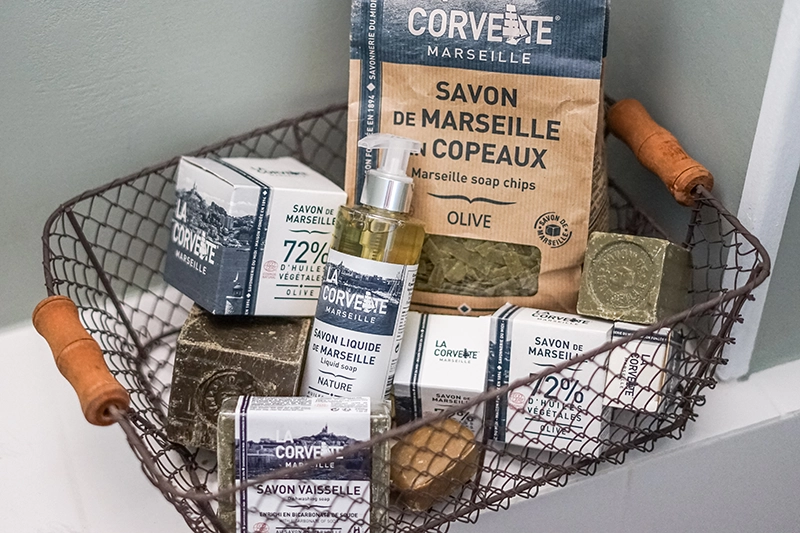
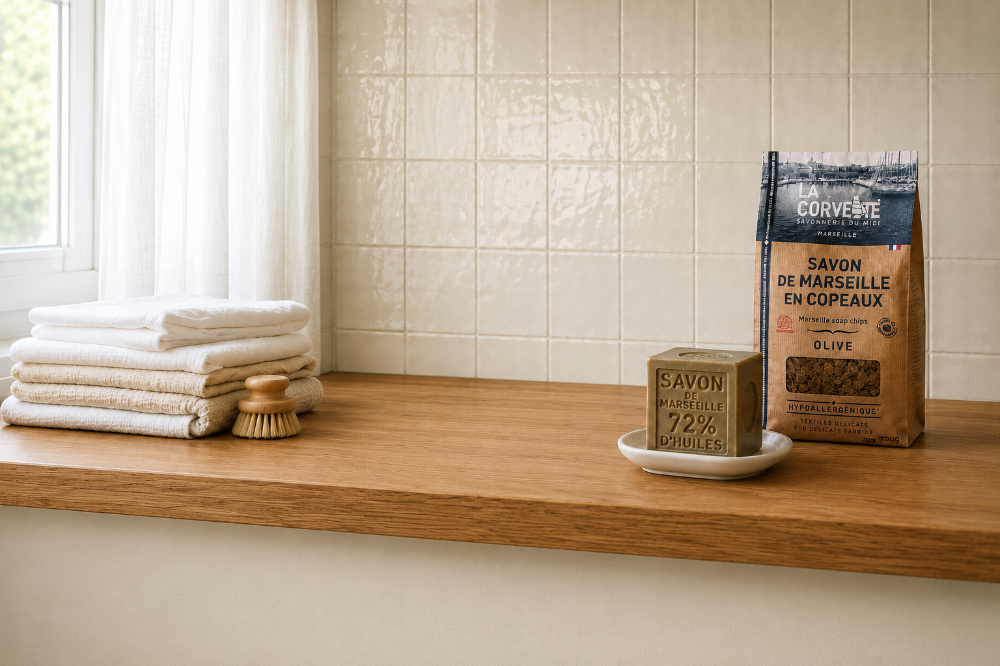
La Corvette is produced by Savonnerie du Midi, a historic Marseille soap factory founded in 1894. Its authentic Marseille soap is still made in Marseille using the traditional cauldron process.
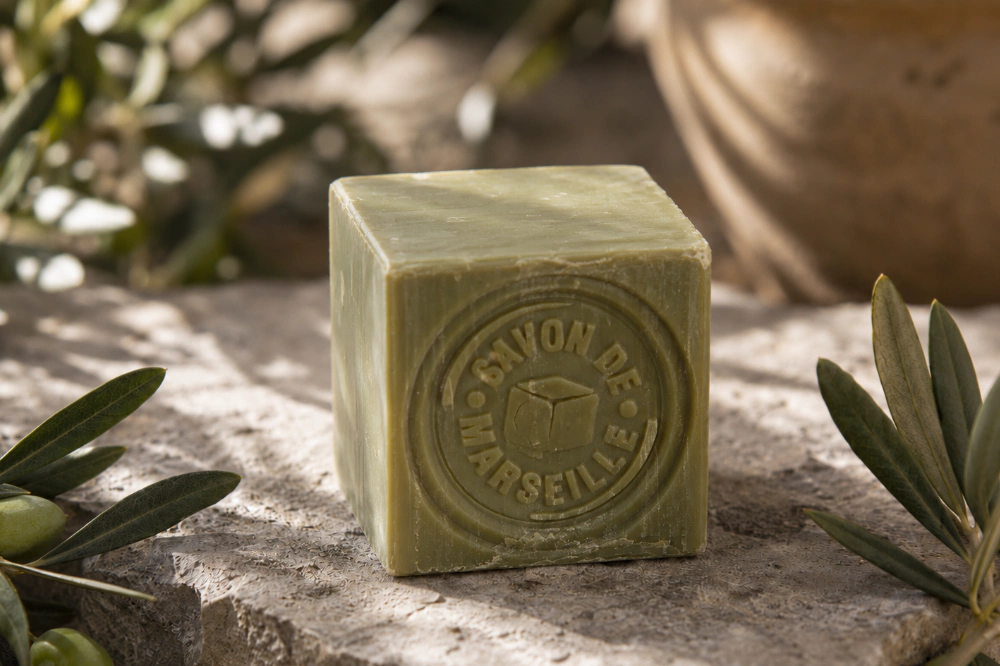
The familiar green olive-oil cube contains 72% vegetable oils and is made without added perfume or colourants. Its identity comes from the ingredients, the traditional manufacturing method and more than a century of expertise.
Perhaps that’s what makes traditional soap particularly interesting today. Personal-care routines have become increasingly complicated, yet a well-made bar of soap can still begin with remarkably simple principles: carefully chosen oils, saponification and time.
You can experience the process yourself through an olive oil soap recipe, or discover how that same basic chemistry evolved into one of Europe’s most enduring soap-making traditions.
Discover the Authentic La Corvette Marseille Soap with Olive Oil Here